
Goodyear has announced a multi-year extension of its partnership with the FIA and the Automobile Club de l’Ouest (ACO), confirming its role as the exclusive tire supplier for the LMGT3 category in the FIA World Endurance Championship (WEC) through 2029. The agreement reinforces Goodyear’s long-term commitment to endurance racing at the highest level. Goodyear was selected at the end of a tender evaluation that considered a range of criteria, including tire performance across varying track and weather conditions, safety, sustainability, cost, the manufacturer's experience in supplying tires for LMGT3 competition, and the level of technical and operational support provided to teams.
As part of this continued partnership, Goodyear will introduce a new generation of Goodyear Racing Eagle tire specifications for the LMGT3 class in both the FIA World Endurance Championship (WEC) and European Le Mans Series (ELMS) from 2027, further strengthening its focus on innovation in top-level endurance racing. This next step reinforces Goodyear’s leadership in bringing sustainable materials into real-world competition, translating innovation into tangible performance on track. With a clear pathway to scalability and industrialization, Goodyear is ensuring that advancements developed in racing can be credibly transferred beyond the track. Backed by a robust and forward-looking development roadmap Goodyear continues to set the benchmark for the future of endurance racing.
“This extension reinforces Goodyear’s long-term commitment to endurance racing as a platform for innovation”, said Xavier Fraipont, Goodyear Racing Vice-President. With the next generation of Eagle tires from 2027, we are not only raising the bar in performance but also accelerating our journey to have tires with higher levels of sustainable-material content in top-tier competition”.
“Goodyear has played an important role in the success and development of the LMGT3 category since its introduction in the FIA World Endurance Championship. Extending this partnership through 2029 reflects a shared ambition between the FIA, the ACO and Goodyear: to ensure strong sporting consistency while continuing to drive innovation. The introduction of a new generation of tires from 2027, combining high-level performance with increased sustainable material content, perfectly illustrates the direction endurance racing must continue to take — where technological excellence and responsibility go hand in hand.”
Pierre Fillon, President of the Automobile Club de l'Ouest
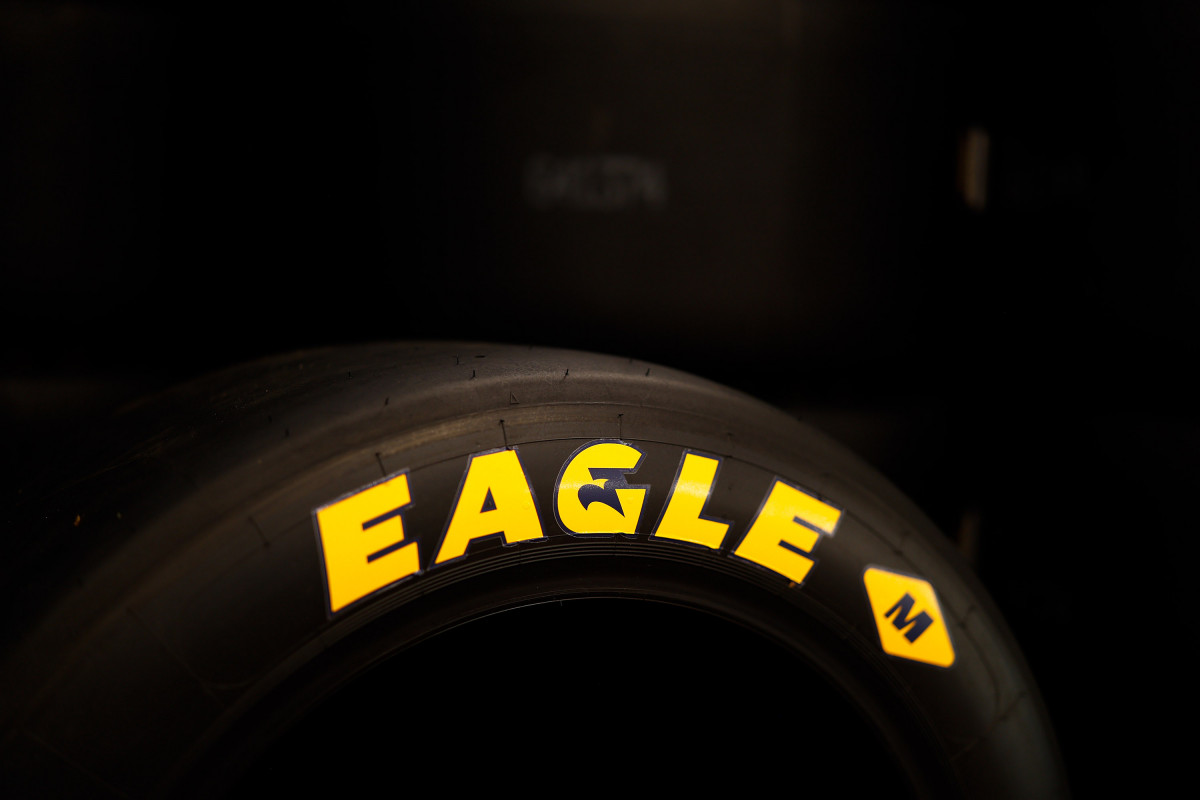
The refreshed range will continue Goodyear’s current single-specification philosophy, with one Goodyear Racing Eagle Medium slick and one Wet tire developed around three key priorities: instant confidence, a wide operating window and an enhanced range of sustainable materials.
Both the slick and wet compounds will contain 66% sustainable materials[1], making them the tires with highest sustainable content in top-level endurance racing and establishing Goodyear as a global leader in sustainable motorsport tire technology.
The new compounds combine recycled and bio-based materials1 including recycled steel, rice husk silica, recycled zinc oxide, and ISCC-certified polymers and carbon black, with bio-based processing aids and sustainable natural rubber. The tires will also debut newly designed Eagle-branded sidewalls, bringing Goodyear’s unmistakable Eagle performance identity even more prominently to the track.
Goodyear has enjoyed three triumphant seasons since the LMGT3 category was introduced in 2024, with its current Goodyear Racing Eagle products becoming renowned for their performance, consistency and broad operating window across changing conditions.
“Developing a tire capable of performing across vastly different circuits, supporting front-, mid-, and rear-engined cars, and meeting the demands of both professional and amateur drivers, is no small feat,” said Fraipont.
“Since the category launched in 2024, we have continuously developed the Goodyear Racing Eagle products using feedback from drivers, teams and manufacturers competing at the highest level of endurance racing. These new specifications are the result of an extensive development process, allowing us to continue delivering world-class performance and consistency while proving that sustainable innovation and elite endurance performance can go hand in hand,” added Fraipont.
Where Performance Meets Its Next Frontier
That philosophy remained central throughout the development process, with Goodyear pushing the boundaries of performance while delivering a tire that inspires confidence from the very first lap, adapts seamlessly to evolving track and weather conditions, and enables teams to execute more dynamic race strategies.
Fraipont added: “At Spa this year, we witnessed the fastest LMGT3 race ever recorded at the circuit. At Le Mans, we expect some teams to complete up to four stints (around 600 km) on a single set of tires. This highlights the remarkable breadth and consistency of performance we are now delivering.
“With this new generation of Goodyear Racing Eagle tires, we continue to advance performance at the highest level. While speed is part of our DNA, endurance racing demands a broader capability combining durability, consistency and adaptability. This is where our focus is fully directed. But this milestone is only one step in a much longer journey. We are already challenging ourselves to go further and move faster. This is not about reaching a specific percentage. It is about redefining what high-performance racing should look like in a more responsible era. Goodyear is already developing the future of Eagle tires with 80% sustainable material-content, which we intend to showcase on track later this year.
“More than a technological achievement, this represents a clear statement of intent: demonstrating that sustainability and uncompromising performance can progress together - and that Goodyear is ready to lead this transformation alongside its partners” concluded Fraipont.
[1] Goodyear definition of sustainable materials: a bio-based (originating from biological sources); renewable (composed of replenishable biomass); or recycled (reprocessed from reclaimed materials) material as defined in ISO 14021; or one produced using or contributing to other practices designed to promote resource conservation and/or emissions reductions.
- 24 Heures du Mans